Bedding guide · Mattress construction
Inside a Vispring Mattress: Pocket Springs, Comfort Layers and Craftsmanship
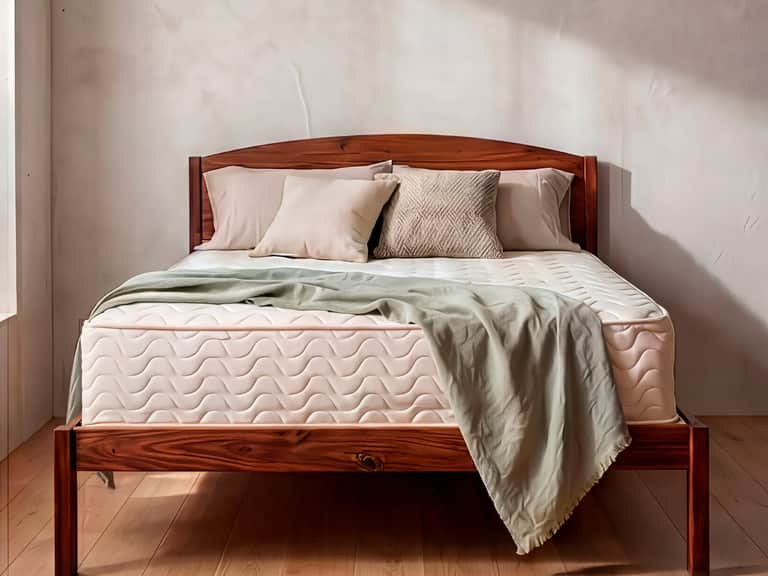
A mattress is a small landscape of materials: a spring system beneath, layers of cushioning above, and a carefully made cover enclosing the whole. Vispring mattresses are associated with pocket-spring support and natural fillings, but their feel depends on how those elements work together. Looking inside the construction can help you compare models with clearer expectations—and ask better questions before choosing.
A mattress is a system, not a single material
From the surface, two mattresses can appear much alike: a level rectangle of fabric, ready for sheets. Underneath, their structures may be quite different. The support core, the arrangement and tension of its springs, the materials layered over it and the way those components are assembled all contribute to the sensation of lying down.
That is why a label such as “pocket sprung” tells only part of the story. It describes an important feature, but does not by itself explain how firm a mattress will feel, how much it will contour around the body, or how readily it will respond when a sleeper changes position. Those qualities emerge from the complete construction—and from the person testing it.
Vispring is known for mattresses that pair pocket springs with carefully selected fillings. Exact materials and specifications differ between models, so it is useful to treat the brand name as a starting point for investigation rather than a guarantee of one particular feel. A careful comparison begins with the spring unit, then follows the layers upwards to the surface.
How pocket springs respond
In a pocket-spring mattress, individual springs are enclosed in fabric pockets. The pockets keep the springs separated, allowing them to compress and rebound with a degree of independence from their neighbours. When weight presses down, the springs beneath that area can respond directly, while those farther away may move less than they would in a more closely connected spring unit.
This local response is one reason pocket springs are often discussed in relation to contouring and movement. A sleeper’s shoulders and hips place pressure in different areas of the mattress; a responsive spring system can react across those changing points rather than behaving as one broad, linked surface. In a shared bed, independent movement may also help limit how much disturbance travels across the mattress. It cannot eliminate motion transfer altogether: the result depends on the entire mattress, its construction and how movement is made.
A connected spring unit behaves differently. Its springs are joined or linked within a common structure, so compression in one area can influence neighbouring sections more directly. That can produce a more unified response across the surface. Neither design is automatically superior. The useful distinction is how the system feels under the body and whether that response suits the people sleeping on it.
Spring count is an easy number to compare, but it is not a complete measure of performance. Counts can refer to different parts of a mattress or to different spring sizes, and a larger figure alone does not establish that a mattress will feel more supportive or comfortable. Spring design, tension, configuration, mattress dimensions and the comfort layers above the springs all matter. Ask what a stated count includes, and compare like with like.
Configuration and tension: the details beneath the surface
Within a pocket-spring mattress, “configuration” may describe the way springs are organised and the number or arrangement used in particular sections. Manufacturers may also offer different spring tensions or options intended to suit different preferences. These details can influence how the mattress responds, but they should not be read as a simple scale where one number or label predicts comfort for everyone.
Body weight, body shape and sleeping posture change how pressure is distributed. A person lying on their side may notice pressure at the shoulder and hip; someone sleeping on their back may pay more attention to how the lower back and pelvis are supported. Two people with similar preferences can experience the same mattress differently, while a couple may need to find a compromise that works for both.
Terminology can vary between ranges. When comparing Vispring models, check the product information for the specific spring arrangement and tension offered, and ask how those terms are defined. If a retailer explains that a mattress is available in different tensions, find out whether that applies to the whole mattress, to separate sides, or to another part of the construction. Do not assume that a description used for one model automatically applies to another.
It also helps to understand the bed base. A mattress is used in combination with a foundation, and the base can affect how the overall sleep surface feels and performs. Check the manufacturer’s guidance on suitable bases and support, particularly if you are replacing only the mattress or using an existing frame. The construction works as a system; the base is part of the context.
Comfort layers: the first contact with the mattress
Above the springs, comfort layers shape the transition between the support core and the sleeper. They influence surface cushioning, pressure relief and the degree to which the mattress seems to mould around the body. Fillings can differ by model, and natural materials are often a notable part of Vispring’s construction. The precise blend, amount and arrangement should be checked for the mattress under consideration rather than inferred from the brand alone.
Natural fillings may include materials such as wool, cotton, hair or other fibres, depending on the model. Each has its own characteristics, but the experience depends on how materials are layered and combined. A filling’s name does not tell the whole story: its position, quantity, density and interaction with the spring unit also contribute to the result. A soft-feeling layer near the surface, for example, will be experienced differently from a resilient layer deeper in the mattress.
These layers can affect warmth and airflow as well as cushioning. Breathability is influenced by the complete construction, including the fillings, cover, quilting and the room environment. It is wise to be cautious about broad promises: no material can ensure that every sleeper will feel cool, and comfort is personal. If temperature is a concern, ask what is used in each layer and consider the bedding, room temperature and sleepwear that will accompany the mattress.
Some mattresses have a more immediate, plush surface; others feel firmer or more buoyant before the body settles into them. These first impressions are useful, but they are not the only measure. Pay attention to whether your body feels supported in your usual sleep position and whether pressure builds at points that normally trouble you. A comfortable top layer should work with the support system, not obscure it.
Craftsmanship and the assembled whole
Craftsmanship in a mattress is more than a reassuring phrase. It concerns how the internal components are selected, arranged, secured and enclosed, as well as the consistency of the finished product. Stitching, quilting, edge construction and the joining of layers can affect both appearance and day-to-day use. These are details worth asking about, particularly when comparing a handmade or traditionally constructed mattress with a different type of build.
Still, workmanship should be understood alongside tangible information. Ask which materials are used, how the mattress is constructed, whether its sides can be rotated or turned, and what care the maker recommends. Check the warranty and its conditions, too. A warranty can explain what is covered and for how long, but it is not a substitute for understanding suitability, maintenance requirements or the way the product is expected to be used.
Mattress weight and depth can also affect practical decisions. A substantial mattress may need compatible bedding, enough clearance in the room and a suitable base. If a model is intended to be rotated or turned, consider whether you can manage that safely and follow the exact care instructions. Do not assume that all mattresses in a range have identical handling or maintenance needs.
The finished mattress brings together elements that cannot be judged independently. A spring core may be responsive, yet the comfort layers can make the surface feel more cushioned. A particular filling may contribute to a distinctive hand-feel, while the tension and layout of the springs influence the underlying support. Construction is an interaction: the whole is what the sleeper encounters.
How sleeping position can guide a comparison
Sleeping position is a useful starting point, not a rigid rule. Side sleepers often look for enough cushioning around the shoulders and hips while still feeling supported through the torso. Back sleepers may focus on a balanced sensation that does not leave the lower back feeling unsupported. People who sleep on their stomach may prefer a surface that limits excessive sinking, though comfort and body shape vary considerably.
When trying a mattress, lie in the position you actually use at home. Give yourself time to settle, and notice whether pressure becomes uncomfortable or whether you feel held up in a way that seems natural. If you share the bed, both sleepers should try it when possible. A brief sit on the edge or a few seconds on your back cannot reveal everything about a full night’s experience.
Ask whether the retailer offers a trial period and read its terms before purchase. Find out how exchanges work, whether collection or delivery charges apply and whether the mattress must be used with a specified base or protector. Policies differ, so rely on the written terms rather than assumptions. This is especially important when buying a substantial, higher-cost mattress that may be difficult to move.
A practical checklist for comparing Vispring models
When product descriptions use evocative language, a short list of concrete questions can make comparison more useful. Keep notes on each model rather than relying on memory after visiting several showrooms.
- What is the spring construction? Confirm the type of pocket-spring unit and what any spring-count figure refers to.
- Which tensions or configurations are available? Ask how the options differ and whether they can be selected independently for each side.
- What are the comfort layers made from? Request the materials and their positions in the mattress, not simply a general description of the filling.
- How does the surface feel in your normal sleeping position? Spend time lying down and consider both cushioning and support.
- What base is recommended? Check compatibility with your existing frame and follow the manufacturer’s support guidance.
- What care is required? Verify whether the mattress should be rotated, turned or maintained in another way.
- What are the delivery, trial and warranty terms? Read the conditions carefully, including exclusions and any base requirements.
- Does it work for both sleepers? If the bed is shared, make the decision together where possible and discuss differences in preference openly.
This approach shifts the comparison away from isolated claims and towards the qualities that shape everyday use. It also makes it easier to identify where two models genuinely differ, rather than assuming that price, spring count or the word “natural” settles the question.
Reading claims with a clear eye
Mattress descriptions often rely on words such as supportive, luxurious, breathable and handcrafted. These can point towards qualities worth exploring, but they are not precise measurements of how a bed will feel. “Support” may refer to the spring system, the full structure or the maker’s intended result. “Natural” describes a broad material category, not a complete account of sourcing, processing or performance.
Look for specific, model-level details and distinguish them from general brand language. If a claim concerns a particular filling or construction, ask where that material appears and what role it serves. If two descriptions use the same word, check whether the underlying materials and design are actually comparable. Clear answers are more useful than a longer list of adjectives.
It is equally important to separate product information from personal prediction. A mattress may be carefully made and use high-quality materials yet still feel wrong to a particular sleeper. Conversely, a simpler construction may suit someone very well. The best choice is not necessarily the most complex or the most expensive; it is one whose feel, support, practical requirements and value make sense for the person using it.
The decision beneath the surface
Looking inside a Vispring mattress reveals a sequence of choices: how the pocket springs are arranged, what tension they provide, which comfort layers sit above them and how those components are assembled. Each choice can shape the experience, but none should be treated as a shortcut to a universal verdict. The same spring count does not guarantee the same feel, and natural fillings do not make every model interchangeable.
For a thoughtful comparison, start with your own needs. Consider sleeping position, preferred firmness, temperature comfort, movement between partners and the type of base you have. Then examine the exact construction of each model, test it in a realistic position and clarify the care, delivery and warranty conditions. A mattress is both an object made of materials and a surface lived on, night after night.
That is the value of understanding what lies beneath the cover. Pocket springs describe one part of the story; fillings, tension and craftsmanship complete it. When those details are considered together—and measured against your own experience—the search becomes less about finding the most impressive specification and more about finding a bed that feels right in the quiet hours when it matters most.